Macramé as Creative Therapy: How Knots, Rhythm, and Patience Unlock Self-Expression
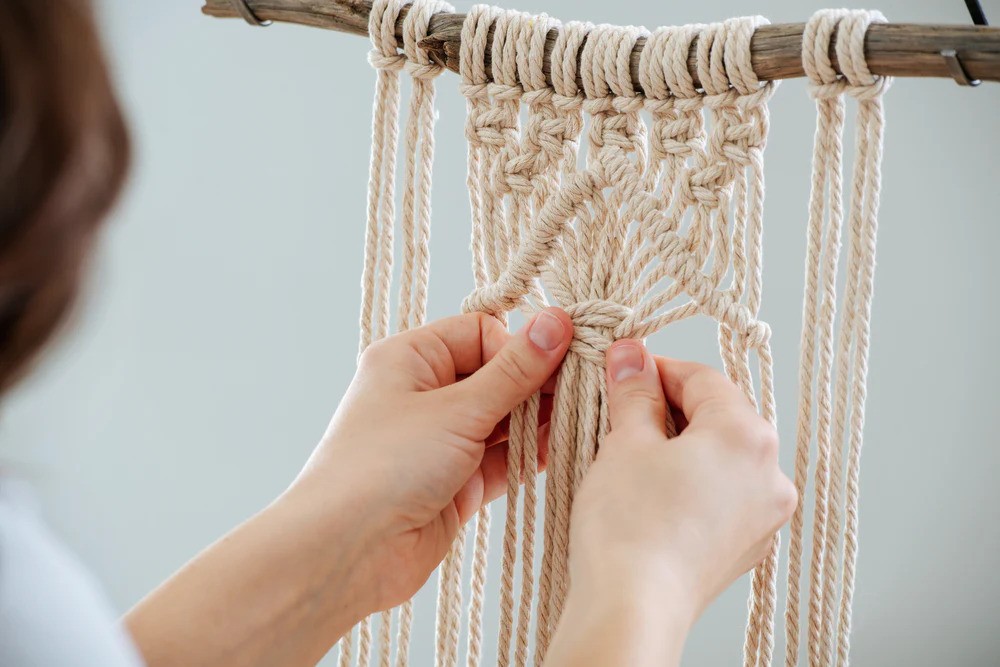
Macramé has quietly moved from the margins of craft culture into the center of modern creative life. Once associated with vintage décor and seaside nostalgia, it is now embraced as a deeply personal, expressive practice. At its core, macramé is not simply about learning knots or producing decorative objects. It is about using the hands to access imagination, patience, and emotional flow. As a form of creative therapy, macramé offers a rare blend of structure and freedom, allowing self-expression to emerge one knot at a time.

Creativity That Begins in the Hands
Creativity is often imagined as something that starts in the mind, but macramé gently reverses that idea. The process begins with touch. Cotton cord sliding between fingers, the subtle resistance of fibers tightening into place, the physical memory of repeating movements. Before ideas fully form, the body is already creating. This tactile beginning lowers the pressure to “be creative” in an intellectual sense and instead invites creativity to surface organically.
In macramé, the hands lead and the mind follows. Repeating knots establish a rhythm that quiets mental noise and creates space for intuition. As patterns emerge, so do decisions about spacing, tension, and flow. These decisions are not calculated in a rigid way. They are felt. Over time, this physical engagement builds confidence in one’s instincts, reminding the maker that creativity does not need to be forced to be valid.
The Language of Knots as Expression
Knots may appear simple, even mechanical, but within macramé they become a language of expression. Each knot carries subtle variation depending on how tightly it is pulled, how it aligns with neighboring cords, and how it interacts with negative space. These differences are where personality lives.
As makers grow comfortable with basic knots, they begin to alter them instinctively. A square knot becomes looser, creating softness. A spiral knot is extended, adding drama. Patterns stretch or compress based on mood and intention. In this way, macramé mirrors emotional states. Calm moments produce balanced, symmetrical designs, while restless energy often results in bold asymmetry and experimentation.
This expressive quality allows macramé to function as a creative outlet without requiring words. Feelings that are difficult to articulate can be worked through physically, embedded into form and texture. The finished piece becomes a quiet record of inner experience, even if the maker never consciously planned it that way.
Rhythm, Repetition, and Creative Flow
One of the most powerful creative aspects of macramé lies in its rhythm. Repetition is not a limitation here. It is an invitation into flow. The steady movement of knotting creates a meditative tempo that pulls attention into the present moment. Time softens. Distractions fade. What remains is the interaction between hands, cord, and emerging form.
This rhythm supports creativity by removing self-judgment. When the body is engaged in repetition, the inner critic loses its voice. There is no rush to innovate or impress. Creativity unfolds naturally as variations occur almost without conscious effort. A slight shift in angle, an unexpected gap, or a spontaneous change in direction can transform the entire piece.
Macramé teaches that creativity does not always arrive as sudden inspiration. Often, it grows out of sustained attention and patience. The rhythm creates conditions where imagination feels safe to surface, free from pressure or performance.

Patience as a Creative Skill
In a culture that values speed and instant results, macramé insists on patience. Knots cannot be rushed without consequence. Cord remembers tension. Mistakes reveal themselves slowly. This slowness is not an obstacle to creativity but one of its greatest allies.
Patience in macramé trains the maker to stay with the process rather than fixating on the outcome. As hours pass, creative decisions accumulate gently instead of all at once. This gradual unfolding allows ideas to mature. It also creates space for reflection. Makers often discover that what they thought they were creating evolves into something unexpected, and patience makes room for that transformation.
Over time, this relationship with patience extends beyond the craft. Creativity becomes less about chasing results and more about honoring process. The maker learns to trust that expression will emerge if given time, attention, and care.
Creative Freedom Within Structure
Macramé is uniquely suited to creative exploration because it balances structure and freedom. The knots provide a framework, but within that framework there is endless possibility. This balance is especially liberating for those who feel intimidated by blank canvases or unstructured creative practices.
Knowing a handful of knots gives the maker a foundation to build upon. From there, creativity appears in choices. Lengths can vary. Patterns can be interrupted. Negative space can be emphasized. Materials can shift from traditional cotton to jute, wool, or even unconventional fibers. Color can remain neutral or explode into bold contrasts.
This controlled freedom helps creativity feel approachable. There is always something to hold onto, but never a single correct outcome. Each piece becomes a conversation between intention and discovery, structure and spontaneity.
Personal Style Emerging Through Process
One of the most rewarding aspects of macramé as creative therapy is watching personal style emerge naturally. Unlike practices that emphasize replication or strict technique, macramé encourages subtle deviation. Over time, these deviations become recognizable signatures.
Some makers gravitate toward minimalism, letting space and simplicity speak. Others layer texture until pieces feel dense and expressive. Some prefer symmetry and order, while others lean into organic, flowing forms. None of these preferences need to be declared or planned. They surface through repetition and choice.
This organic development of style builds creative self-trust. Makers begin to recognize their own visual language and feel more comfortable expressing it. The process becomes less about following instructions and more about listening to inner preference.

Macramé as a Safe Space for Experimentation
Creativity thrives in environments where mistakes are allowed, and macramé offers exactly that. Knots can be undone. Sections can be reworked. Nothing is permanent until the maker decides it is. This flexibility creates a sense of safety that encourages experimentation.
Trying something new in macramé carries low risk but high reward. A small change can dramatically alter the final piece. This invites playfulness and curiosity, qualities often lost in adult creative lives. Makers begin to ask “what if” rather than “what’s right.”
This mindset shifts creativity from performance to exploration. The process becomes enjoyable regardless of outcome, and expression feels lighter, more honest, and more personal.
Emotional Presence Through Making
While macramé is often discussed for its calming qualities, its creative impact goes deeper than relaxation. It encourages emotional presence. The act of making requires attention, and attention creates awareness. Feelings surface naturally when the hands are occupied and the mind is quiet.
Rather than suppressing emotion, macramé allows it to coexist with creation. Frustration, joy, restlessness, and contentment can all move through the hands without needing resolution. The cord absorbs tension. The rhythm holds space. Creativity becomes a container for emotional experience.
This emotional honesty is what gives macramé its therapeutic power as a creative practice. Expression does not need explanation. It simply needs space.
Rediscovering Creativity Without Pressure
Many people believe they are not creative because they associate creativity with talent or productivity. Macramé gently challenges this belief. It does not demand originality or mastery. It invites participation. Creativity becomes something you do, not something you prove.
By focusing on process rather than outcome, macramé helps reconnect people with a natural creative instinct that may have been neglected or dismissed. The simple act of tying knots becomes a reminder that creativity is accessible, physical, and deeply human.
In this way, macramé functions as creative therapy not by fixing anything, but by restoring connection. Connection to hands, to time, to intuition, and to self-expression.
Creativity That Extends Beyond the Cord
The creative lessons learned through macramé rarely stay confined to the craft itself. Patience, trust in process, comfort with imperfection, and confidence in intuition begin to influence other areas of life. Writing feels less intimidating. Problem-solving becomes more flexible. Self-expression feels safer.
Macramé teaches that creativity is not about constant innovation. It is about presence, repetition, and willingness to explore. Each knot is a small act of attention, and together they form something meaningful.
Through knots, rhythm, and patience, macramé opens a quiet but powerful doorway into self-expression. Not through grand gestures, but through steady hands, curious minds, and the simple beauty of making something that did not exist before.